Hundred is younger than the other three brands on this page by decades, not years — launched around 2021 out of Singapore’s Sunlight Sports Group — and it has grown fast by signing real playing pedigree, including a 2025 partnership with former world number one Kidambi Srikanth. That is a useful signal in a category where most new brands compete on price alone.
The frame construction Hundred leads with
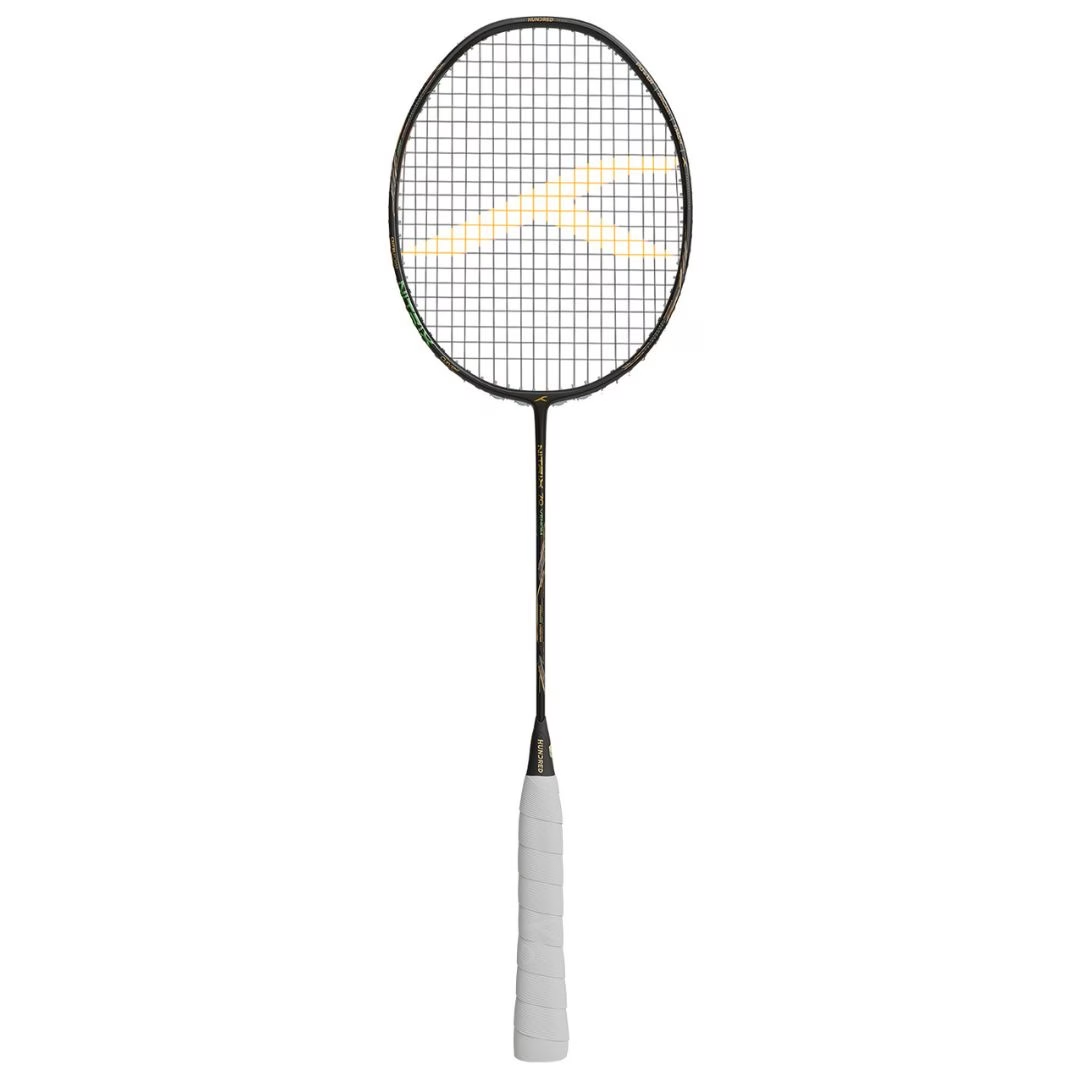
Hundred’s higher-tier frames are built around what it calls M46X carbon paired with a T-Fuse core at the T-joint, the junction where head meets shaft and where twisting forces concentrate on an off-centre hit. The stated goal is the same one every serious racket brand chases — explosive repulsion on the sweet spot without the frame flexing sideways the moment contact drifts off-centre — and the CURVE² frame shaping is Hundred’s answer to the aerodynamics-versus-stability trade-off that also drives Li-Ning’s frame design.
CNTRLFOAM, used inside parts of the frame on some models, is a control-oriented damping layer — it is there to settle vibration after contact rather than to add power, which matters more for consistency on defensive shots than it does for the smash.
Where the range sits
The Nitrix series is Hundred’s head-heavy, attacking line — the Nitrix Volta 70 is built explicitly around explosive repulsion for players who want power from the back court. Flareon and Hyfonic sit at different points on the control-versus-power spectrum, which is the same three-way split every established racket brand ends up offering once its range matures past a single flagship model.
The honest case for trying it
A newer brand has less of a second-hand market and less long-run reputation to lean on than Li-Ning or Yonex, and that is worth knowing before buying. What it offers in return is current-generation carbon layup and frame engineering at a price point that undercuts the legacy brands doing the same job — which is exactly the gap Hundred was built to fill, and why it has moved fast enough to attract sponsored players rather than just selling on price alone.
Who Hundred actually suits
It suits a specific, common kind of buyer better than the marketing lets on: someone who already knows roughly what weight, balance and flex they want — from having played a Li-Ning or Yonex frame before, or from a coach’s recommendation — and is looking for that same specification without the legacy-brand premium attached to it. Hundred is a much harder sell to a first-time buyer with no reference point, simply because there is less accumulated word-of-mouth and fewer club-mates likely to have tried the exact model in front of them.
The signing of a genuinely world-class player is worth weighing carefully rather than dismissing as marketing spend. A brand competing on price alone does not typically get a former world number one to put their name on the racket bag; a professional at that level has options and reputational risk in choosing badly, so the partnership is a real signal about where the brand sees its own engineering standing, not just its budget.
Questions
- Is a newer racket brand riskier to buy?
- The main practical risk is a smaller second-hand market and fewer long-term durability reports than a 30-year-old brand, not a construction shortcut — Hundred’s carbon layup and frame engineering are current-generation, not a step down.