Stringing is the one piece of racket setup that gets changed constantly and understood the least. Two players with the same racket, same weight, same balance, can feel like they are playing with completely different equipment purely because of gauge and tension — and both of those are choices, not fixed specs.
Gauge: thickness is a trade, not an upgrade
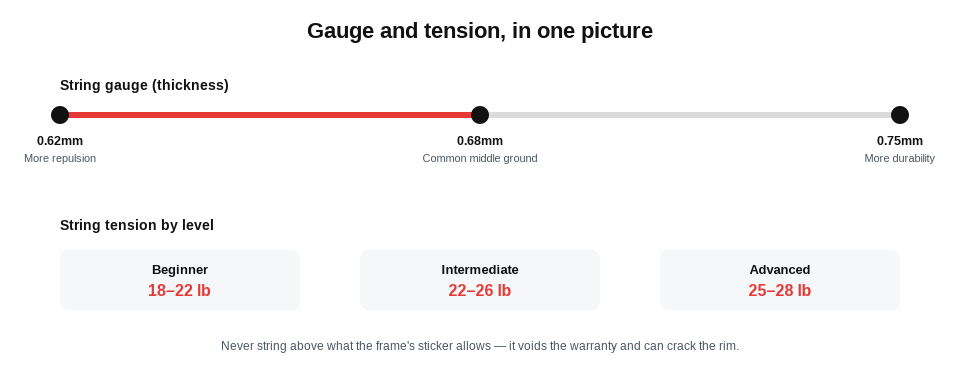
String gauge is measured in millimetres, typically between about 0.61mm and 0.70mm, and it is a genuine trade-off rather than a hierarchy of good-to-better. Thinner strings — around 0.62 to 0.66mm — flex more on impact, creating a trampoline-like repulsion effect and more feedback through the frame, which is why more advanced and offensive players lean thinner. Thicker strings, 0.67mm and up, sacrifice a little of that repulsion for meaningfully better durability, which matters most to anyone who hits hard, plays often, and does not want to restring every second week.
Tension: matched to level, not to how hard someone can pull it
Tension is measured in pounds, and higher is not simply better — a tighter string bed gives more control and a smaller, crisper sweet spot, but it also demands more precise, consistent technique to use well. A player without that consistency yet gets more forgiveness, a bigger sweet spot and easier power from a lower tension.
- Beginner: 18–22 lb — forgiving, larger sweet spot, easier power
- Intermediate: 22–26 lb — the balance most club players settle on
- Advanced: 25–28 lb — crisper feel, smaller margin for a mistimed hit
The one rule that overrides personal preference
Every racket has a maximum recommended tension printed near the throat or on the specification sheet, and stringing above it is not a minor risk — it can crack the frame at the grommet holes and will void the manufacturer’s warranty outright. That ceiling is the actual starting point for choosing tension; personal preference only applies within whatever range the frame is rated for.
Putting gauge and tension together, for real
Gauge and tension are usually explained as two separate decisions, but they are chosen together in practice, and the four rough combinations suit genuinely different players rather than forming a simple ladder from worst to best.
Most players are better served working out which of the four descriptions below matches how they actually play, then asking a stringer for gauge and tension together, rather than picking a tension number in isolation and hoping the gauge sorts itself out.
- Thin gauge + low tension — very forgiving and lively, but strings will not hold their setting long; a practice-court combination more than a match one
- Thin gauge + high tension — the combination advanced, offensive players reach for: crisp feedback and a small, precise sweet spot, at the cost of breaking sooner under hard hitting
- Thick gauge + low tension — durable and forgiving together, a sensible default for anyone just building consistency who does not want a restring every few weeks
- Thick gauge + high tension — control-focused and durable, the combination many defensive doubles players and coaches restring to, trading a little repulsion for a string bed that holds its setting through a long session
Questions
- How often should a racket be restrung?
- A common rule of thumb is to restring as many times a year as you play per week — playing three times a week suggests roughly three restrings a year — but a snapped string or noticeably dead repulsion is the more reliable signal than any fixed schedule.
- Does thinner string really break faster?
- Generally yes. Thinner gauge trades some durability for repulsion and feel, and most players report needing a restring after three to five intensive sessions on the thinnest gauges, versus meaningfully longer on a thicker string.
- Should gauge or tension be decided first?
- Gauge first, because it caps how the string will ever feel regardless of tension — a thick, durable gauge strung tight still will not match the crispness of a thin gauge. Decide how much durability you are willing to trade away, then set tension within your racket’s rated range.