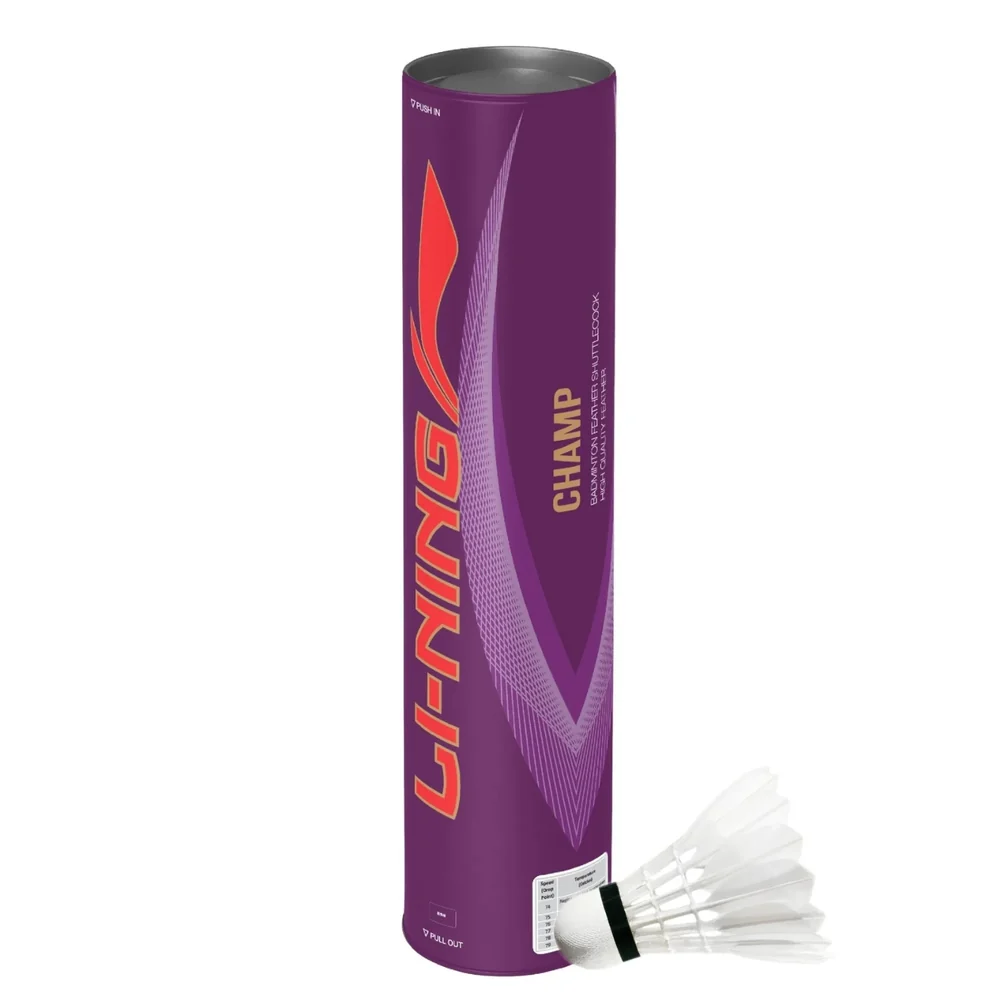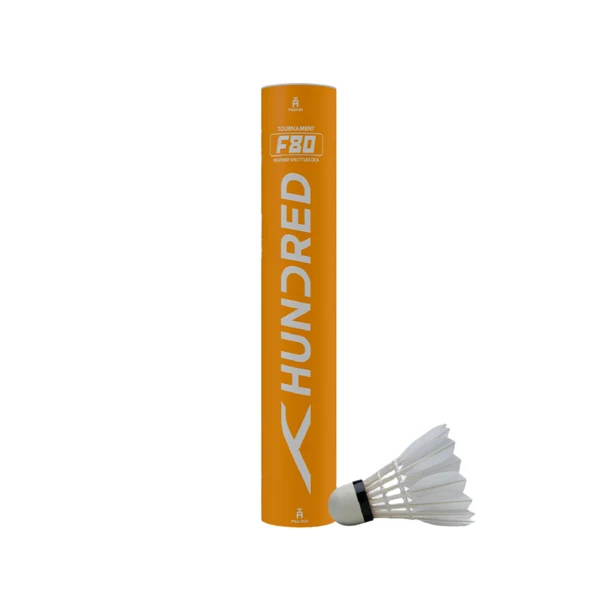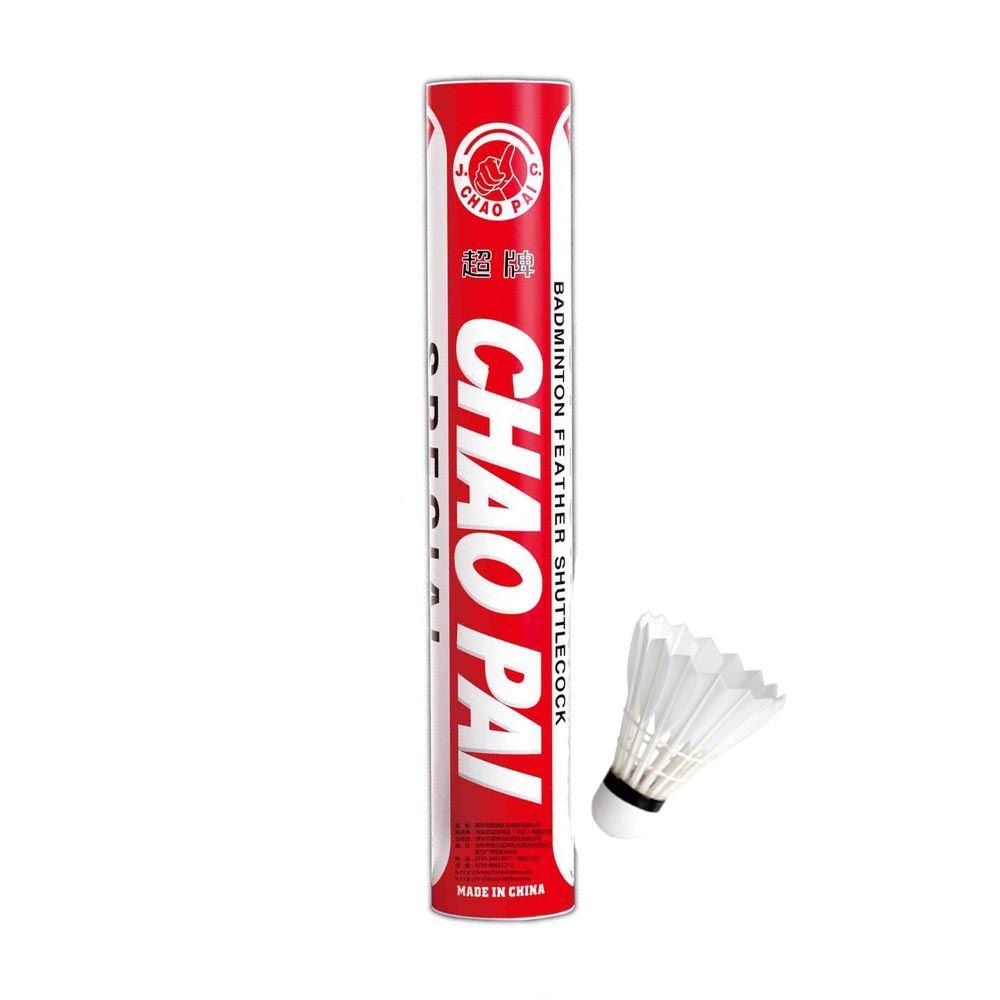
Every shuttlecock does the same job — it has to fly straight, decelerate fast, and land point-first — but a feather shuttle and a synthetic one get there by completely different routes, and the gap in feel between them is bigger than the gap between most rackets.
Why feather still wins on feel
A feather shuttle is built from sixteen goose or duck feathers set into a cork base, and no two are ever perfectly identical — which is exactly why they behave the way they do. The natural taper and overlap of real feathers create drag that increases sharply as the shuttle slows, so a smash that starts fast dies quickly near the back line rather than sailing through. That fast start and hard stop is the flight every serious player is used to, and it is very hard to fake with plastic.
The trade-off is durability. A feather shuttle splits after 20–40 minutes of hard hitting, sometimes sooner on a mishit against the frame, and a full tube gets through in a single serious session for two players. That cost is the price of the flight — nobody has found a way around it yet.
Where synthetic actually makes sense
A nylon or plastic skirt over a rubber or cork base survives a mis-hit that would end a feather shuttle instantly, and one shuttle can outlast a dozen feather ones in a beginner session. The flight is close enough for drilling footwork, serving practice and casual games — it only falls short in the fine control of a slice drop or a tight net exchange, where the exaggerated late-flight drag of real feather is what separates a shuttle landing on the line from one landing a foot long.
For a club running junior sessions or open-play nights, synthetic is the economically sane choice. For anyone training seriously or playing competitively, the flight difference shows up in the first few rallies.
Reading the speed number
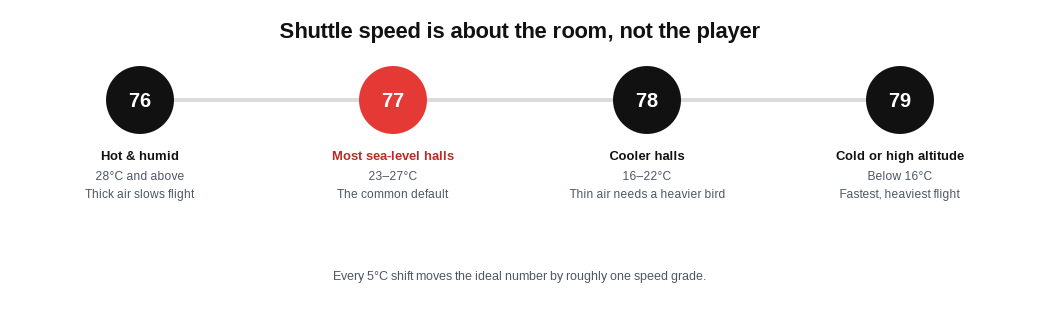
Feather shuttles are graded 76 through 79, and the number has nothing to do with skill level — it is about air density. Warmer, thicker air at sea level slows a shuttle down, so it needs a lighter, faster-rated bird to travel the same distance; colder or higher-altitude air is thinner and needs a heavier one. As a rough guide, every 5°C shift in room temperature moves the ideal speed by about one grade.
- 76 — hot, humid halls (28°C and above)
- 77 — most sea-level venues (23–27°C), the common default
- 78 — cooler halls (16–22°C)
- 79 — cold rooms or high altitude, below 16°C
Reading a shuttle before you ever hit it
You can tell a lot about a feather shuttle before a single rally. Hold it by the cork and look down the skirt from above: the sixteen feathers should form an even, symmetrical circle with no gaps and no feather sitting noticeably higher or lower than its neighbours — an uneven set is what makes a shuttle wobble in flight rather than fly straight, and it will feel wrong on the very first serve. Press a thumb gently into the cork; it should feel dense and give almost nothing, not soft or spongy. A soft cork bruises and deforms after only a handful of hits, and a bruised cork is usually why a shuttle that flew fine ten minutes ago suddenly starts knuckling sideways.
One more habit worth building: buy shuttles by the tube, and once a tube is open, keep the lid on between sessions. Feathers dry out and turn brittle in open air over days, which is why a tube opened three weeks ago plays noticeably worse than one opened this morning, even with the same number of hits on it.
The decision, laid out plainly
If the session is drilling footwork, teaching a beginner to serve, or a casual social game where nobody is counting speed points, synthetic is not a compromise — it is the right tool, and the money saved is real across a season. If the session involves anyone genuinely training their game, working on slice drops, or playing a match that matters, feather is not a luxury; the fine control it gives at slow shuttle speeds is exactly the skill those sessions are meant to build, and a synthetic shuttle will not teach it honestly.
Many serious club players end up running both: synthetic for the first twenty minutes of warm-up and footwork, feather once the session moves into real rallies. That split gets the durability where it is wasted on synthetic and the flight quality where it actually matters.
Questions
- How many feather shuttles does one session use up?
- For two players hitting hard, a single shuttle typically lasts 20 to 40 minutes before a feather splits or the flight goes soft. A tube of 12 covers roughly one to two hours of genuinely competitive rallying.
- Can a synthetic shuttle be used in competition?
- Club and casual matches often allow it, but sanctioned tournaments almost always require feather. Check the specific competition rules before assuming either way.
- Why does a shuttle that flew fine last week suddenly feel wrong?
- Almost always a dried-out or bruised cork, or feathers that have gone brittle sitting in an opened tube. Feather shuttles are a perishable good, not a one-time purchase — treat an open tube the way you would treat anything else that degrades in open air.